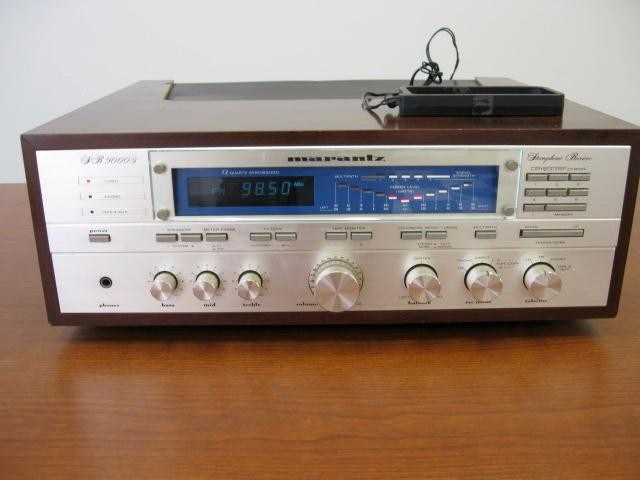
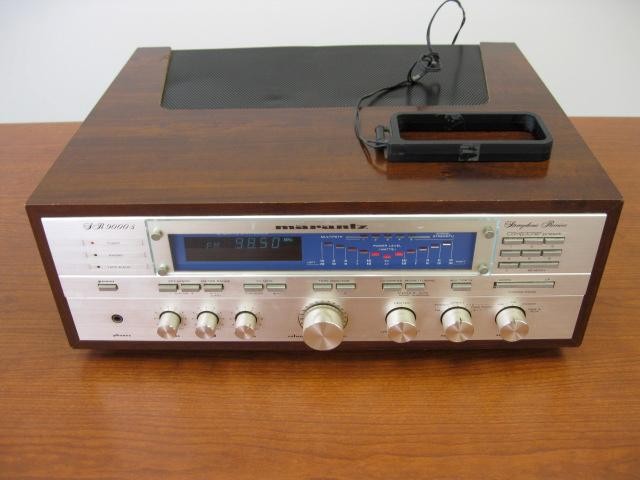
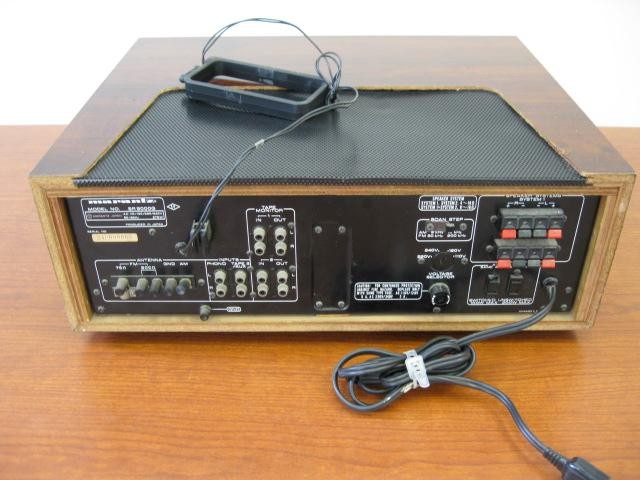
The 1979 Marantz SR9000G retailed for $950.00 and has the distinction of being Marantz's first Digital Tuner equipped receiver. Although not as big and powerful as the awesome Model 2600 it replaced at the top of the Marantz lineup, it was still a 1970's Monster Receiver in its own right at 150w/ch. However, it marked a turning point in Marantz's fortunes, as the Company began a downhill slide after it was taken over by Dutch electronics giant Philips.
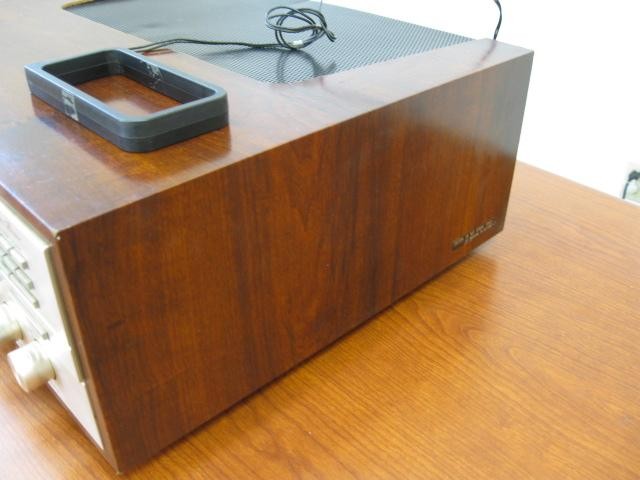
The SR9000G was a Monster with obvious signs of cost cutting. The buttons were plastic, and not metal. Gone were to Toroidal power transformers and "dual secondary" power supplies. Gone were the double ganged tone controls and the brand-identifying "Gyro-Touch" tuning. The wood case was now covered with vinyl rather than real wood veneer. Although the SR9000G was actually under development before Phillips took over, it sent all the wrong "mass market" signals to the loyal customers who had been devout followers of the Marantz brand during the 60's and 70's.
The SR9000G is now an extremely rare Monster. Very few exist. I have been able to find almost nothing about mine on the Internet, except on a German site, which did not translate very well. I took my SR9000G over to my friend Tom Ishimoto's shop and he benchtested it at 150w/ch, 20-20kHz at 0.022% THD, a performance that puts it in the Monster Receiver league, albeit barely. Tom later become the Manager of Product Development for Marantz, and even he did know about the SR9000G. That's how rare a bird it is.
But, issues of cost cutting aside, I must confess that the SR9000G performs very nicely, in fact, flawlessly. And, with a Quartz Digital Synthesized Tuning section, for 1979, it was very advanced. I have compared it side by side with a Marantz 2325, considered by many as the "high-water mark" for Marantz receivers, and it gives up very little sound-wise over a variety of different music. And, even though it is filled with plastic bits and pieces, it does have "Marantz DNA" combined a distinctive look that has grown on me with the passage of time. At first the "champagne" finish on the extruded aluminum faceplate looks a bit tacky, but, with the passage of time, it becomes very handsome in a world of black plastic.
|